- Your cart is empty
- Continue Shopping


Product Description
You Are Still Functioning. That Doesn’t Mean You’re Okay.
The classic picture of burnout — the person who has disengaged, gone cynical, stopped caring — is not the most common presentation in women. The more common pattern is different, and more insidious: you are still delivering. Still meeting your obligations. Still being the person others depend on. You are just completely, utterly hollow inside.
Researchers call this ‘exhausted over-functioning.’ It is driven by the same qualities that make many women exceptional performers: the tend-and-befriend stress response that prioritises connection over withdrawal, the perfectionism that maintains standards even under depletion, and the approval-seeking that makes declining requests feel socially dangerous.
These are not weaknesses. They are strengths — that, without structural protection, become the mechanism of burnout.
The Burnout Code: Women’s Edition addresses female burnout specifically — the second shift and total load, the emotional labour that never appears on any to-do list, the hormonal cost as chronic stress suppresses the menstrual cycle, and the identity patterns that keep high-achieving women over-functioning long after their reserves have run out.
This is not a generic burnout guide with a female lens applied. It is a female burnout guide, from the ground up.
—
What Makes Female Burnout Different
Before the four-phase recovery begins, the guide addresses the specific mechanisms that produce burnout in women — and why most burnout frameworks fail to address them:
- The second shift — The domestic and care labour performed after paid work. Research consistently shows women in dual-income households perform significantly more unpaid labour. When total load (professional + domestic + emotional) is calculated, many women are working 70-80 hour weeks. A burnout protocol that only addresses professional load misses half the problem.
- Emotional labour — Managing others’ emotions at work and home. It does not appear in job descriptions or domestic negotiations. It is invisible, uncounted, and depletes the same finite cognitive resources as any other work.
- The tend-and-befriend over-commitment cycle — Under stress, the neurological drive to maintain connections and meet obligations intensifies — precisely when reducing load is most physiologically necessary. Burnout and the tend-and-befriend response create a self-reinforcing trap.
- The hormonal cost — Chronic stress directly suppresses the HPO axis through CRH-mediated GnRH inhibition. The result: cycle irregularity, worsened PMS, shorter luteal phases, lighter periods. Your cycle changing in a period of high demand is not coincidence or hormonal disorder. It is a measurable physiological signal.
- The performance mask — The maintained presentation of capability that prevents recognition of burnout by others — and often by the woman herself.
—
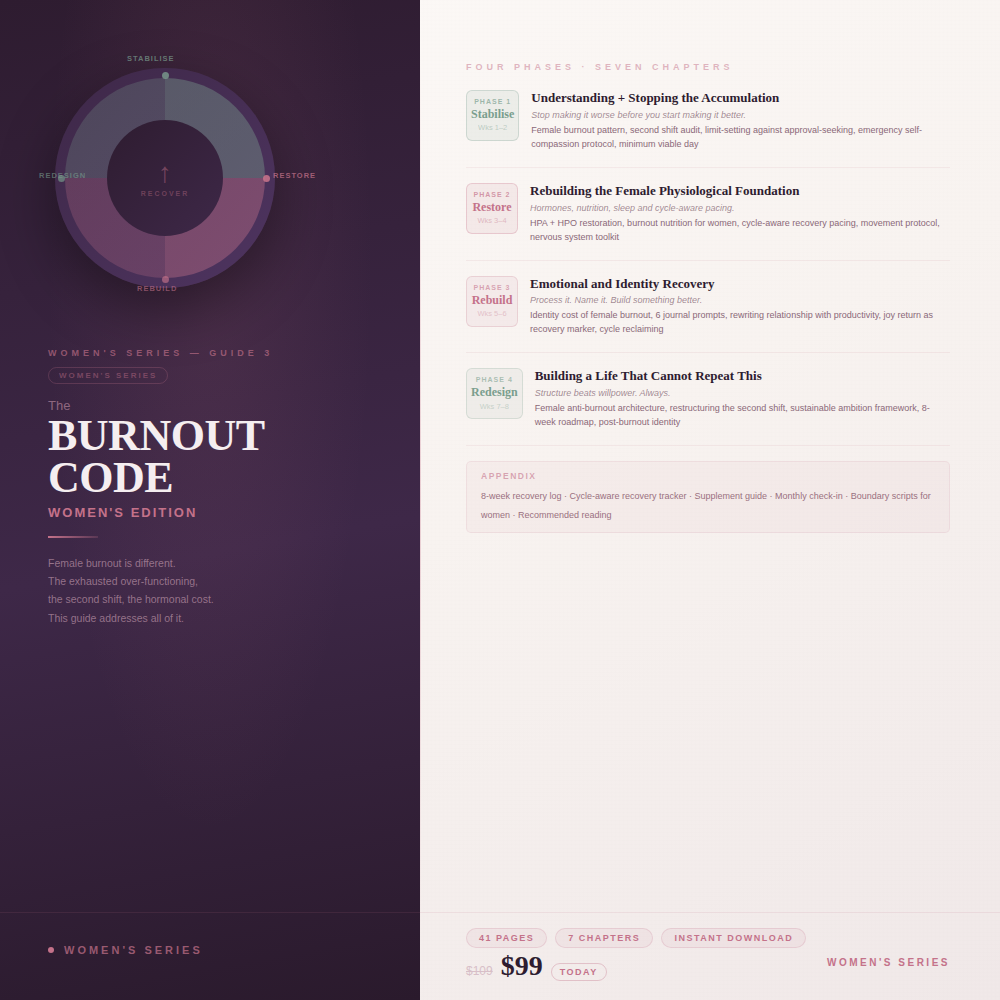
Four Phases. Seven Chapters.
PHASE 1 — STABILISE (Weeks 1–2)
Introduction — Female Burnout: Why It’s Different
The exhausted over-functioning pattern, why female burnout is underdiagnosed, the four dimensions specific to women, PMDD awareness, and when to seek medical support.
Chapter 1 — Understanding the Female Burnout Pattern
The second shift and total load, emotional labour as hidden drain, the tend-and-befriend over-commitment cycle, perfectionism as burnout accelerant, the hormonal cost of chronic stress, the performance mask, and social comparison in the burnout shame cycle.
Chapter 2 — Recognising Where You Are
The female burnout continuum (5 stages with female-specific presentations), the exhausted over-functioning recognition guide, the cycle as an early warning system (with a table of specific cycle changes and what they signal), and the Female Burnout Self-Assessment (12 items, scored at Weeks 1, 4, and 8).
Chapter 3 — Stopping the Accumulation
The female-specific total load audit (10 categories including domestic labour, mental load, and emotional labour), limit-setting scripts against the approval-seeking response, the emergency self-compassion protocol (the three-step practice), the minimum viable day for women, and the Phase 1 sleep protocol.
—
PHASE 2 — RESTORE (Weeks 3–4)
Chapter 4 — Rebuilding the Female Physiological Foundation
Hormonal restoration — HPA and HPO axis, the HPA-HPO restoration table (6 interventions with evidence), female burnout nutrition (iron, magnesium, omega-3, B vitamins, protein, complex carbs), cycle-aware recovery pacing (what to prioritise in each phase during recovery), the movement protocol for female burnout (week-by-week from walking to progressive training), and the nervous system toolkit for women (six practices including breathwork, social connection, nature, and yoga nidra).
—
PHASE 3 — REBUILD (Weeks 5–6)
Chapter 5 — Emotional and Identity Recovery
The identity cost of female burnout, six structured journal prompts for processing guilt, resentment, grief, and anger, rewriting your relationship with productivity, the joy return as a recovery marker, the identity rebuilding exercise (four-step template), and relationships during recovery.
—
PHASE 4 — REDESIGN (Weeks 7–8)
Chapter 6 — Building a Life That Cannot Repeat This
The female anti-burnout architecture (5 pillars with female-specific versions), restructuring the second shift (a conversation framework for use at ovulation), limits that hold against approval-seeking (pre-decision strategy), the sustainable ambition framework, and the quarterly values and load review (six questions).
Chapter 7 — Your 8-Week Female Recovery Protocol
The complete 8-week roadmap table, the 90-day post-recovery plan, re-entry to full capacity (three stages with timing), the Women’s Series integration (how this guide works alongside Cycle Sync and The Female Performance Protocol), a final word, and the post-burnout identity statement template.
—
The Appendix
- 8-Week Female Burnout Recovery Log — Phase-coded daily tracker with 5 habits per phase and a 14-day grid per phase
- Cycle-Aware Recovery Tracker — 8-week weekly tracker including cycle phase, energy, sleep, PMS severity, cycle regularity, and burnout warning signs — designed to be compared within phases across months
- Female Burnout Supplement Guide — 8 supplements prioritised specifically for female burnout, with dosing, timing, female-specific roles, and clinical notes
- Monthly Recovery Check-In — Five structured prompts with writing space for monthly self-directed recovery management
- Boundary Scripts for Women — Six ready-to-use scripts for the most common limit-challenging situations: declining work, communicating burnout to a partner, responding to guilt-inducing pushback, and communicating with HR
- Recommended Reading — Five essential books with explanations, including Burnout by Emily and Amelia Nagoski, The Second Shift, Self-Compassion by Kristin Neff, and others
—
How This Guide Fits With the Rest of the Women’s Series
The Burnout Code: Women’s Edition is designed to complement — not duplicate — the other Women’s Series guides:
- Cycle Sync (Guide 1) — The cycle-phase scheduling guide. During recovery, use Cycle Sync’s framework to pace your recovery work with the hormonal capacity of each phase. After recovery, use it for long-term performance optimisation.
- The Female Performance Protocol (Guide 2) — The comprehensive female performance system. After recovery, this guide provides the complete biological, cognitive, and identity framework for high performance that this guide’s recovery creates the space for.
- The Burnout Code: Women’s Edition (Guide 3) — This guide. Use it now, and at any future point when load exceeds capacity.
All three guides together form the Complete Women’s Series Bundle — the complete female wellbeing and performance operating system.
—
This Guide Is For You If…
- You are still functioning but feel completely empty inside
- You have tried to manage burnout with more organisation, better habits, and a positive mindset — and it hasn’t worked
- Your menstrual cycle has changed in a period of sustained high demand
- You carry a significant domestic and care load on top of your professional responsibilities
- You find it genuinely difficult to say no — and feel guilty when you do
- You are the person everyone relies on, and you are exhausted by it
- You want a recovery framework that addresses the actual causes of female burnout, not the generic version
—
How This Differs From the Burnout Recovery Protocol
The general Burnout Recovery Protocol in our catalogue is a comprehensive 65-page guide to burnout recovery addressing allostatic load science, HRV-guided tracking, and the complete four-phase physiological recovery protocol. It is the deeper physiological text.
The Burnout Code: Women’s Edition is the female-specific guide — focused on the causes, presentations, and recovery pathways specific to women: the second shift, emotional labour, the hormonal dimension, the tend-and-befriend over-commitment cycle, and the identity patterns most prevalent in high-achieving women.
They are designed to complement each other. Read the general Burnout Recovery Protocol for deep physiological science; use this guide for the female-specific framework and tools.
—
30-Day Money-Back Guarantee
Complete the female burnout self-assessment, work through Chapters 1 and 2, and begin Phase 1. If you do not find the framework genuinely relevant to your experience, contact us within 30 days for a full refund.
—
Product Details
- Format: Instant download PDF — premium typeset, professionally designed
- Pages: 41 (A4, print-ready)
- Language: English
- Includes: Introduction, 7 chapters across 4 phases, appendix with 6 tools
- Compatible with: Any PDF reader, tablet, phone, or printer
- Delivery: Instant — download link on confirmation page and email
- Published: 2026 · Women’s Series · Premium Edition
—
“You are not recovering to who you were. You are recovering to who you were always meant to be when the load was appropriate and the identity was yours.”
© 2026 SerumsFit. All rights reserved. For personal use only. Educational purposes — not medical advice.
—
5 reviews for The Burnout Code: Women’s Edition — Female Burnout Recovery in Four Phases (Premium Digital Guide)
Only logged in customers who have purchased this product may leave a review.
Martina V. –
What I valued most about this guide is its honesty about timelines. It doesn’t promise recovery in 30 days. It tells you that genuine recovery from burnout takes months and gives you the tools to navigate that honestly. The identity section — on how burnout affects your sense of self — was unexpectedly profound. This is not a quick fix guide. It is a proper recovery system.
Rebecca A. –
Most burnout resources ignore the hormonal dimension entirely. This guide doesn’t. The section on how chronic stress disrupts the female hormonal system — cortisol’s relationship with oestrogen and progesterone — explained patterns I’d been experiencing for years without understanding. The recovery framework is specific, compassionate, and evidence-based.
Ingrid H. –
What I appreciated most is that this guide does not promise you will feel better in two weeks. It is honest that burnout recovery is measured in months, not days. That honesty made the process more manageable — I was not failing when I was still tired at week three, I was on track. The four-phase framework with clear criteria for progressing between phases was exactly the structure I needed.
Stephanie L. –
I’d been dismissing my exhaustion as a personality flaw for about three years. Reading this guide made me understand that what I was experiencing had a physiological basis and a recoverable pathway. The four-phase framework is clear and realistic. The boundary-setting section was the hardest but most important part for me. Six months later I feel like myself again.
Katherine L. –
I spent three years in a slow burnout that I did not recognise as burnout because I was still functioning. I was not hospitalised, I was not unable to work — I was just running at 40% and calling it normal. This guide has a section on high-functioning burnout that described my situation exactly. That recognition was the first step. The recovery framework gave me the rest.