- Your cart is empty
- Continue Shopping


Product Description
Burnout Is Not a Mindset Problem. Stop Treating It Like One.
You have tried pushing through it. You have tried the holiday, the detox, the new morning routine. You have told yourself to be more resilient, more disciplined, more grateful. None of it is working — because none of it is addressing what burnout actually is.
Burnout is a physiological condition. At the biological level, it is a state of chronic allostatic overload — the accumulated wear and tear on every regulatory system in your body from sustained, unrelieved stress without adequate recovery. Your HPA axis is dysregulated. Your cortisol rhythm is flat. Your autonomic nervous system has lost its flexibility. Your prefrontal cortex — the seat of rational thinking, emotional regulation, and decision-making — is functioning at a fraction of its capacity.
This is why willpower doesn’t fix it. The very organ you would use to plan your recovery is one of the primary casualties of the condition you’re trying to recover from.
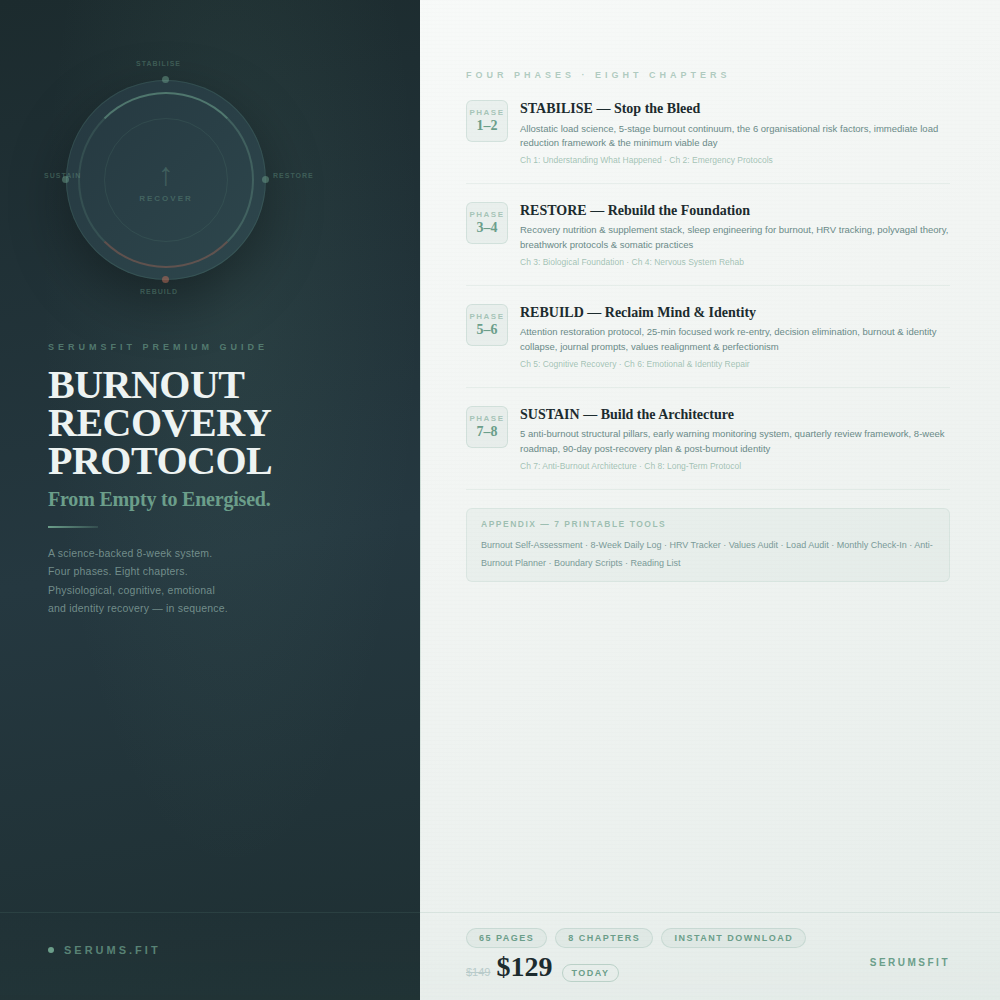
The Burnout Recovery Protocol treats burnout like what it is: a physiological problem requiring a physiological solution. An 8-week, four-phase system — grounded in allostatic load science, polyvagal theory, HRV research, and clinical recovery frameworks — that rebuilds your biological, cognitive, emotional, and identity foundations in the correct sequence.
—
Who This Is For
- You are exhausted in a way that sleep alone is not fixing
- You feel simultaneously tired and unable to fully rest
- Your emotional range has narrowed — it is hard to feel genuinely positive
- Your cognitive performance has declined: fog, poor memory, difficulty focusing
- You have cynicism or resentment toward work that didn’t used to be there
- You feel like you have lost yourself — not just your energy, but your identity
- You have burned out before, recovered partially, and repeated the cycle
—
The Four-Phase System
⬡ PHASE 1 — STABILISE (Weeks 1–2): Stop Making It Worse
Before you can recover, you have to stop the accumulation. Phase 1 is clinical triage — not optimisation.
- Chapter 1 — Understanding What Happened to You — The allostatic load science, the 5-stage burnout continuum, why high achievers are most vulnerable, the six organisational risk factors (Maslach), and self-compassion as a clinical recovery tool
- Chapter 2 — Emergency Protocols: Stopping the Bleed — The 3-tier load reduction framework, non-negotiable Phase 1 boundaries, the guilt of doing less and why it’s a nervous system response, sleep as medicine, and the Minimum Viable Day protocol
⬡ PHASE 2 — RESTORE (Weeks 3–4): Rebuild the Biological Foundation
The body first. Recovery is physiological before it is psychological.
- Chapter 3 — Rebuilding Your Biological Foundation — Recovery nutrition protocol with burnout-specific priorities, movement as medicine (not performance), the complete sleep engineering sequence for burnout, the 7-supplement recovery stack with evidence ratings, and HRV-guided tracking protocol
- Chapter 4 — Nervous System Rehabilitation — Polyvagal theory applied to burnout recovery, the parasympathetic activation toolkit (6 tools with protocols), 5 breathwork techniques with use-cases and mechanisms, the role of safe social connection as a physiological intervention, and a full somatic practices guide for burnout
⬡ PHASE 3 — REBUILD (Weeks 5–6): Reclaim Mind and Identity
With the biological foundation restored, the cognitive and emotional work becomes possible.
- Chapter 5 — Cognitive Recovery: Reclaiming Your Mind — Cognitive fatigue vs regular tiredness, the 6-step attention restoration protocol, the distraction trap in recovery, decision elimination strategies, the 25-minute focused work re-entry protocol, and measuring cognitive recovery progress
- Chapter 6 — Emotional Recovery and Identity Repair — Burnout and identity collapse, 6 structured journal prompts for processing grief and resentment, values realignment, rewriting your relationship with work, the perfectionism-burnout connection, relationships after burnout, and when professional support is appropriate
⬡ PHASE 4 — SUSTAIN (Weeks 7–8): Build the Architecture
Recovery without structural change produces relapse. Phase 4 makes relapse structurally impossible.
- Chapter 7 — The Anti-Burnout Architecture — Why burnout recurs (the 50% relapse statistic), the 5 structural pillars with fill-in design templates, the early warning monitoring system (7 indicators), the quarterly meaning alignment review framework, the boundary communication framework, and honest assessment of organisational vs individual burnout
- Chapter 8 — Your Long-Term Recovery Protocol — The full 8-week day-by-day roadmap table, the re-entry checklist (3 stages), the 90-day post-recovery plan, and your post-burnout identity statement
—
Closing + Full Appendix
A closing section on the timeline of recovery, the compound recovery effect, and what recovery actually feels like as it happens.
Appendix includes 9 printable tools:
- Burnout Self-Assessment — 10 dimensions, scored at Weeks 1, 4 and 8
- 8-Week Daily Protocol Log — 4 phases × 5 habits per phase, 14-day grid
- HRV and Recovery Tracker — 8 weeks with energy and sleep scores
- Values Alignment Audit — values identification, time allocation gap analysis, one-change commitment
- Weekly Load Audit Template — 9-slot commitment inventory with eliminate/delegate/defer columns
- Monthly Prevention Check-In — 6-month tracker with reflection questions
- Anti-Burnout Architecture Planner — all 5 pillars with fill-in fields
- Boundary Scripts — 5 ready-to-use scripts for the most common boundary challenges
- Recommended Reading — 6 essential books with explanations
—
What Separates This From Generic Burnout Content
Most burnout content is written for people who haven’t burned out yet — it’s prevention content dressed up as recovery content. It tells you to take breaks, practise gratitude, and set better limits. This guide is written for people who are already depleted.
The difference:
- It is sequenced correctly — Phase 1 before Phase 2, biology before cognition, stabilise before optimise. Most burnout advice puts the cart before the horse.
- It treats burnout physiologically — HPA axis, polyvagal theory, HRV, allostatic load, sleep architecture. Not just psychological frameworks.
- It addresses identity — The most neglected and most important dimension. Without this, recurrence is almost inevitable.
- It builds permanent infrastructure — Phase 4 creates structures that prevent relapse rather than relying on ongoing willpower.
- It is honest about timelines — Recovery takes 3–18 months depending on severity. This guide does not promise a quick fix. It provides what a genuine recovery actually requires.
—
A Note on Scope
This guide is designed for self-directed use by people experiencing burnout who retain the capacity for structured self-intervention. It is not a substitute for professional medical or psychological care. If you are experiencing clinical depression, thoughts of self-harm, or complete inability to function, please consult a qualified healthcare professional. This guide is designed to complement, not replace, professional clinical care where needed.
—
30-Day Money-Back Guarantee
Implement Phase 1 for 14 days. If you don’t notice any reduction in allostatic symptoms — improved sleep consistency, reduced emotional reactivity, or any measurable change — contact us within 30 days for a full refund.
—
Product Details
- Format: Instant download PDF — premium typeset, professionally designed
- Pages: 65 (A4, print-ready, high-quality layout throughout)
- Language: English
- Includes: 8 chapters + closing + appendix with 9 printable tools
- Compatible with: Any PDF reader, tablet, phone, or printer
- Delivery: Instant — download link on confirmation page and email
- Published by: SerumsFit | serums.fit | First Edition, 2026
—
“You cannot pour from an empty cup. But first, you have to stop pouring.”
“Rest is not idleness.” — John Lubbock
© 2026 SerumsFit. All rights reserved. For personal use only.
—
5 reviews for The Burnout Recovery Protocol — From Empty to Energized (Premium Digital Guide)
Only logged in customers who have purchased this product may leave a review.
Sophie R. –
I was in full burnout when I bought this. Unable to concentrate, emotionally flat, running on fumes. The guide does not promise a quick fix and that honesty was itself reassuring — it meant I could trust the rest of it. The four-phase framework gave me structure when I had none. Ten months later I am genuinely recovered and have not relapsed. This guide was a significant part of that.
Michael B. –
I’d been dismissing my symptoms as laziness for two years before reading this. The burnout assessment at the start made it clear that what I was experiencing was a physiological state, not a character flaw. That reframe alone was worth the price. The nervous system section is particularly good — it explained why I couldn’t just push through and why rest wasn’t working until I addressed the underlying dysregulation.
Craig A. –
That was me six months ago. I thought burnout was a mindset issue and that I just needed more discipline. This guide explained clearly why that thinking makes it worse, not better. The nervous system dysregulation content was the breakthrough. Once I understood what was happening physiologically I stopped fighting it and started working with it. Recovery followed.
Laura S. –
I was fully burned out when I bought this — not just tired, actually unable to function at work. The four-phase framework gave me something to hold onto when everything felt chaotic. I appreciated that it doesn’t promise a quick fix — it’s honest that recovery takes months and gives you a realistic roadmap. Eight months later I’m back to full capacity and haven’t relapsed.
Annette D. –
What distinguishes this guide from other burnout resources is the tone — it’s clinical enough to be credible but warm enough to feel supportive when you’re at your lowest. The four-phase structure gave me clear milestones. I knew where I was in recovery at all times, which reduced the anxiety of not knowing when I’d feel normal again.